Talking about film and format


When deciding what film format to shoot first, here are some things to consider:
Film choice: Even with our choices seemingly getting slimmer every day, there are still
some amazing films in both 35mm and 120 format out there, if you know where to look.
The Film Photography Store has some great choices of black and white and colour, as
do Lomography. The classics from Kodak and Ilford are still around and are some of my
favourites. The choice of film for 120 is slightly smaller and a bit more expensive per roll than 35mm. The choices for 4x5 and 8x10 are even slimmer.
Check out a local camera store and see what they have. If they don’t have what you
want, see if they will order it for you. It may take a bit longer, but supporting your local
camera store is really important. Your local camera store can be a great resource if you
have questions or issues with film, cameras or chemistry.
Consider the environment you’ll be shooting in, so you can choose the right film speed,
or ASA (also called ISO).
Higher speed films are more sensitive to light, but they will have larger grain structure
(these larger silver halide crystals can capture more light). Your images with these films
will have a much more defined grainy texture.
Slower speed films are less sensitive to light and have a tighter grain structure, making
the texture of the image much smoother.
When shooting an indoor location, with subdued light, you generally want a faster speed film, but you can also “Push Process” your film by rating the film speed higher and developing longer. You are basically underexposing your film in camera and
compensating for this when you develop your film. For example, shooting 400 ASA
Tmax at 800 or 1200 and pushing the development will effectively give you a higher
speed film, but this has drawbacks in that you will lose some of the midtones and your
contrast will be higher. Shooting in this way will give you a different look than shooting a faster, grainier film.
If you are shooting outdoors in daylight, you will generally want a slower speed film. If a slower speed film isn’t available, you can “Pull Process” your film, rating it slower than normal (basically over exposing the film) and shortening development time. The trade-off here can be a loss of contrast.
The Massive Development Chart can be really useful for determining your development
times with different films and developers.
.
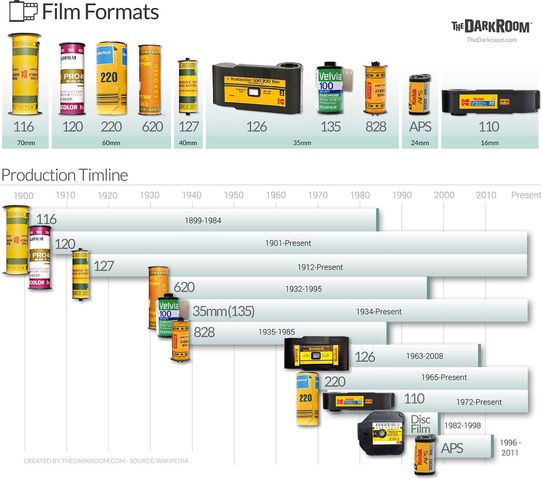
When shooting a new-to-you film, make sure to order multiple rolls so you can shoot
test rolls. Shoot the film in different environments and lighting situations. Consider what developers you might use and test those as well. This way you can get your head
around how the film will behave before shooting something really important.
Exposures per roll: 24 exposures or 36 are the norm for 35mm. (If you roll your own, you can get as many as 40 per roll.). If you are shooting with ½ frame 35mm cameras (such as the Olympus Pen F), you can double this.
With 120, your exposures per roll are determined by your format.
645 = 16 exposures
6x6 = 12 exposures
6x7 = 10 exposures
6x9 = 8 exposures
6x12 = 6 exposures.
Negative Size: 35mm film has an image size of 24x36mm (35mm refers to the gauge of
the film). Half Frame 35mm measures 18x24mm (see image below of Half frame 35mm
next to 35mm)
120 film sizes are:
645 (commonly called 2 ¼) measures 56mm x 42mm
6x6 measures 56mm x 56mm
6x7 measures 56mm x 67mm (this is often called the “perfect format”, because it
enlarges perfectly to 8x10 without cropping)
6x9 measures 56mm x 84mm
6x12 measures 56mm x 118mm (This format is shot with Panoramic cameras such
as The Noblex.)
The large number of format types for 120 make it versatile for all types of image making, although the main advantage of the larger negative size of the medium formats is that you can make bigger enlargements with less apparent grain. With the newer T-Grain films, grain is almost invisible.Depth of Field: Medium and large formats are said to have lower overall depth of field.
This is true from a certain point of view. But it’s really based on lens coverage and
format size. Larger formats need longer lenses to cover the image area. This video
explains it comparing Micro four-thirds to 35mm size sensors, but the same applies to
film formats. If you think of it in terms of standard focal length lenses for each format, it will make more sense. This chart from Wikipedia details “normal lenses” for various
formats (calculated by measuring the diagonal of the image size):

Film format Image dimensions Image
Normal lens focal
diagonal
length
9.5 mm Minox 8 × 11 mm 13.6 mm 15 mm
Half-frame 24 × 18 mm 30 mm 30 mm
APS C 16.7 × 25.1 mm 30.1 mm 28 mm, 30 mm
135, 35mm 24 × 36 mm 43.3 mm 40 mm, 50 mm, 55
mm
120/220, 6 × 4.5 (645) 56 × 42 mm 71.8 mm 75 mm
120/220, 6 × 6 56 × 56 mm 79.2 mm 80 mm
120/220, 6 × 7 56 × 68 mm 88.1 mm 90 mm
120/220, 6 × 9 56 × 84 mm 101.0 mm 105 mm
120/220, 6 × 12 56 × 112 mm 125.0 mm 120 mm
large format 4 × 5 sheet
93 × 118 mm (image 150.2 mm 150 mm film area)
large format 5 × 7 sheet
120 × 170 mm (image 208.0 mm 210 mm film area)
large format 8 × 10
194 × 245 mm (image 312.5 mm 300 mm sheet film area)
Longer lenses have a shallower depth of field and cover more image area, so larger
formats (requiring longer lenses to cover the larger image area) will have shallower
depth of field.
Final thoughts:
Your choice of films and format won’t make you a better or worse photographer. It’s
simply a choice. What you choose and why are up to you.
Shoot with intention. Choose your format and film to suit what you want to achieve.
Shoot tests to know what you can and more importantly, what you can’t do with the film and format you choose.Developing the film you shoot will give you ultimate control over the images you make.
The most important point: Have Fun. If this becomes frustrating and more like work, take a step back and re-evaluate your process.
Enjoy your image-making !
Gregg.


Comments